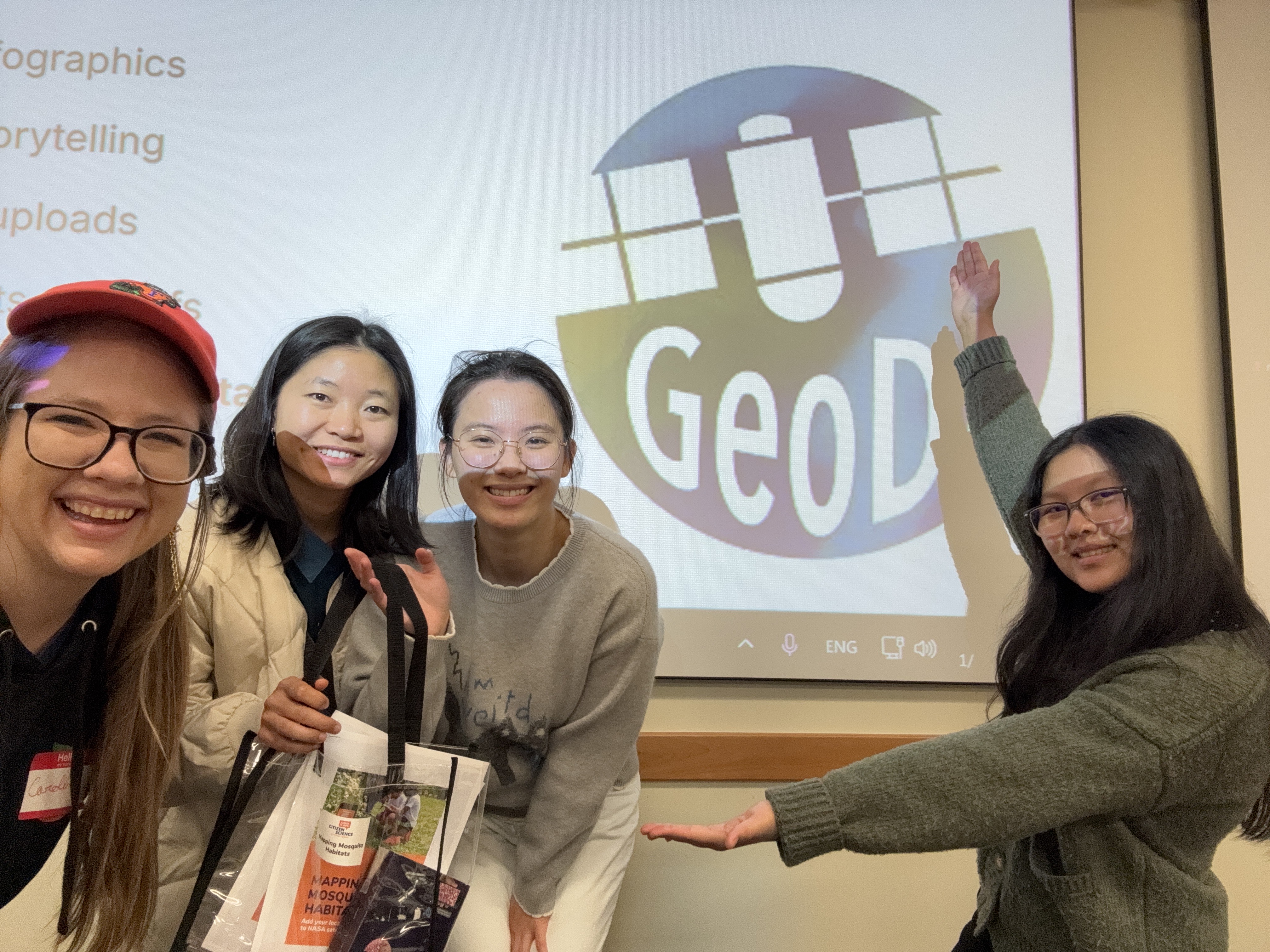
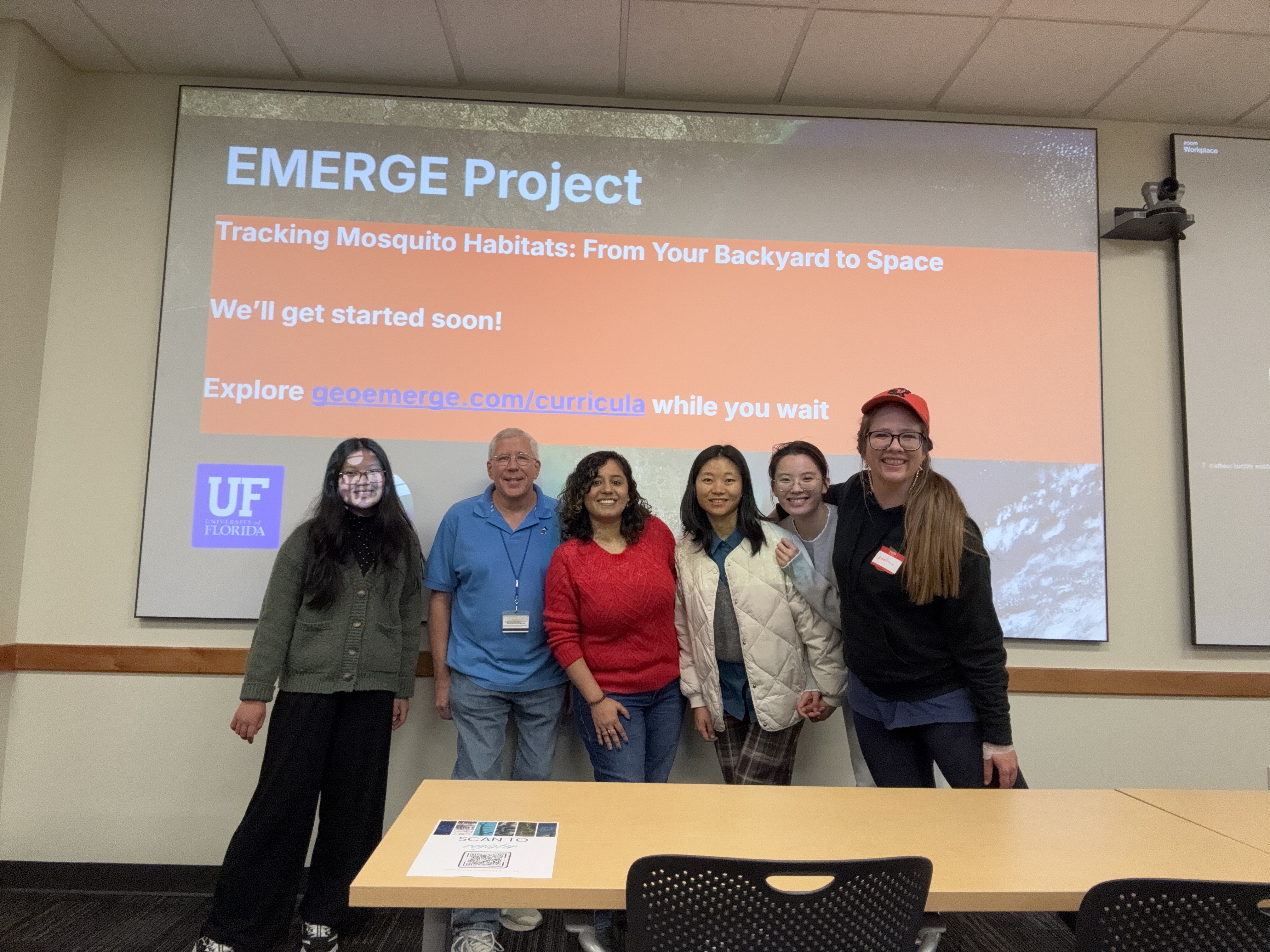
On January 31, 2026, students, library staff, researchers, and community members gathered at the University of Florida (UF)’s Marston Science Library for the EMERGE NASA Data Hackathon.
From morning workshops to an end-of-day sprint, participants spent a day transforming real environmental data into maps, dashboards, infographics, and practical insights that can support public health and environmental decision-making.
The event was hosted by the Geospatial Digital Informatics Lab (part of the Geography Department at UF), SciStarter (the world’s largest citizen science database), and Florida Community Innovation (a civic tech nonprofit), with support from NASA and UF Libraries.
What Is EMERGE?
EMERGE stands for Environmental Monitoring through Education, Research, and Geospatial Engagement. Run by UF’s GeoDI lab, it is an initiative in Florida and beyond to empower libraries, educators, and individuals to engage in public health and environmental science using real-world data tools and citizen science.
At the center of EMERGE is GLOBE Observer, a NASA-supported community science program that allows anyone to collect and explore data on mosquito habitats, land cover, clouds, and more.
The hackathon gave participants a chance to work directly with these citizen-collected datasets and see how local observations connect to global research. Participants had access to a digital textbook created by the GeoDI Lab that explains how to download, process, visualize, and analyze GLOBE Observer data.
The science and outreach of EMERGE is possible with the support of NASA through the Citizen Science Seed Funding Program (CSSFP), with the goal of enabling more scientists to develop and use citizen science techniques in their work. The geospatial AI extension of EMERGE is possible with the support of ESIP through Democratizing Geospatial AI/ML.
Why this Hackathon?
A hackathon is a time-limited, collaborative event where participants work together to explore data, learn new tools, and create projects, and this hackathon was intentionally designed as a gentle, welcoming entry point for UF students and community members at all experience levels.
It was also a little shorter than most hackathons, but we think it was valuable because it lowered the barrier to participation!
Hackathon Workshops
We started the day with workshops. Dr. Caroline Nickerson, a globally recognized participatory science expert, provided an introduction to citizen science.
Then, Dr. Yichan Li, postdoctoral associate at the GeoDI Lab, presented an analysis of environmental data in combination with the GLOBE mosquito observations, giving hackathon attendees a general look at how the data can be analyzed.
Our last workshop before hacking commenced was a conversational Q&A with Peder Nelson, Senior Instructor at Oregon State University and Science lead for Land Cover in NASA’s GLOBE Observer. He also hosted the virtual part of our hackathon, offering mentorship to online attendees.
Throughout the Hackathon, Dr. Natya Hans, the Informatics and Reproducibility Librarian in Academic Research Consulting and Services Department at George A. Smathers Libraries, and Joseph Aufmuth, UF Library’s Geospatial Consultant in the Library’s Academic Research Consulting and Services (ARCS) department, were available as mentors to answer questions.
Celebrating Hackathon Projects
At the hackathon, 13 teams came together to build projects analyzing GLOBE data or reenvisioning data collection for the app. See the gallery of projects here.
Below, we celebrate our winners and honorable mentions, as well as recognized contributions.
APP IMPROVEMENT TRACK
- Winner: Mosquito Tracker
- Honorable Mention: App Improvement Brief
- User Interface Recognition: GLOBE Observer, Simplified
ADVANCED TRACK
- Winner: Epidemiological Vector Mapping System (EVMS)
- Winner: GeoDude
- Honorable Mention: Mosquito Habitat Observations and Wildfire Hazard in Florida
- Mapping Recognition: Mosquitos Worldwide Project
INTERMEDIATE TRACK
- Winner: Swarm Sense
- Honorable Mention: Mosquito Risk Mapping
- Data Analysis Recognition: Bias and Uncertainty in Reported Mosquito Habitat Data
BEGINNER TRACK
- Winner: Beginner Track EMERGE Project
- Honorable Mention: Mosquito Predicting with Globe Observer Data
FIELD TRACK
Next Steps & How You Can Get Involved
Post-hackathon, we’d love to keep this going!
Participants and community members interested in civic tech, public-interest data, and community-centered research are invited to get involved with Florida Community Innovation, one of the Hackathon partners. FCI works year-round with students and community partners to build accessible tools, maps, and public resources, and welcomes new collaborators from a wide range of backgrounds. Get started with FCI by visiting floridainnovation.org, and email info@floridainnovation.org to join one of our Wednesday meetings at 6 PM ET to be matched with a project (like builiding games for Miami-Dade’s Recyclepedia app, helping create an AI tool for social workers in Orlando, and more!).
Those interested in shaping future EMERGE events can also apply to join a small planning committee to help design the next hackathon. Committee members will help think through formats, tracks, accessibility, and community partnerships, with the goal of keeping future events welcoming, practical, and responsive to local needs. Organizers will receive a small honorarium. Email Caroline (caroline.nickerson@floridainnovation.org) to be interviewed for the committee.
Participants are also encouraged to continue using GLOBE Observer beyond the hackathon. Anyone can collect and explore data on mosquito habitats, land cover, and other environmental topics, whether as part of a class, a library program, or individual exploration. Learn more. Continuing to contribute observations helps strengthen the datasets used by scientists while deepening local understanding of environmental conditions.
If you would like to get involved in any of these ways, or explore how EMERGE could support your library, class, or community group, we would love to hear from you. Just send an email to Caroline, our communications lead.
